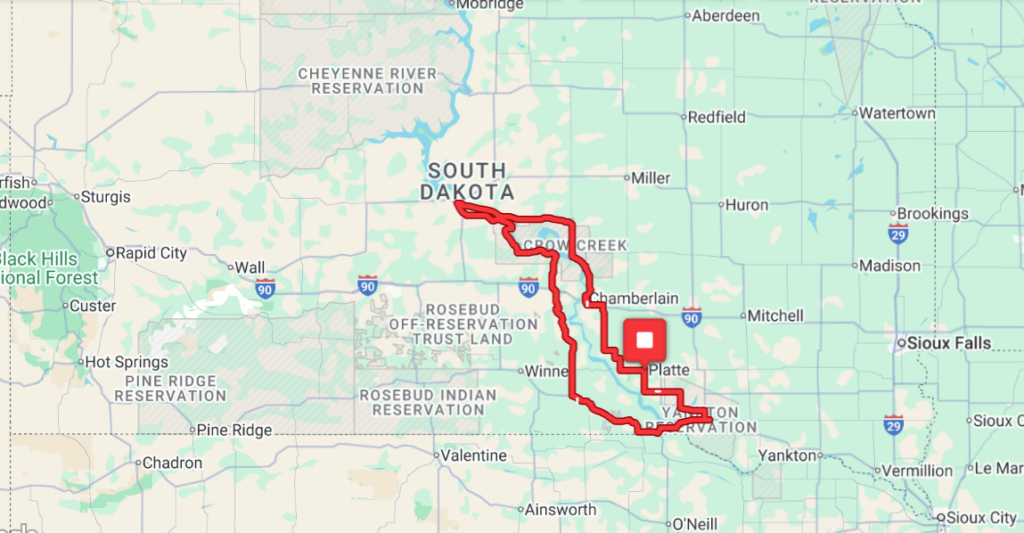
RASDak 2026 Route
Saturday May 30
Platte, South Dakota kicks off the RASDak adventure with a warm welcome and a perfect blend of scenery and history. Just a few miles east of the Missouri River, the area offers beautiful rolling landscapes and wide-open roads ideal for a first day in the saddle. With a population of about 1,300, Platte is known for its friendly community and classic small-town charm, highlighted by historic sites like the Melcher Museum and the Lyric Theatre. After being such an outstanding host during RASDak 2021, Platte stands out as the ideal place to gather riders, roll out together, and launch RASDak 2026.
Sunday May 31
Platte to Chamberlain 53 miles 1080 ft
Plus Snake Creek State Park 60 miles 1464 ft
Riders will have an optional stop at Snake Creek State Park, offering beautiful views of the Missouri River and a view of the longest bridge in South Dakota.
We’ll roll through Academy, named for Ward Academy, a three-story school that served 148 students in 1911. Today, only a historic church and a wide stone memorial remain, quietly marking the town’s past.
The route continues through the Bijou Hills, a National Natural Landmark that has drawn travelers since the days of early French traders and Lewis and Clark. Nearby is a historic cemetery, most notably the resting place of seven members of one family killed by a tornado in 1899. The cemetery will also serve as one of our rest stops—back in 2021, a few seasoned RASDak riders were jokingly offered plots at very reasonable rates for an extra-long “rest” stop.
The route concludes in Chamberlain, where the Missouri River comes fully into view. Riders can explore the new trail leading down to the river and visit highlights such as the South Dakota Hall of Fame.
Monday June 1
Chamberlain to Pierre 85 miles 2810 ft
Today’s ride begins on the Native American Scenic Byway and is a journey straight through South Dakota history, with the Missouri River as our constant guide. Along the route, we’ll pass the site of Fort Kiowa, where frontiersman Hugh Glass famously crawled nearly 200 miles after being mauled by a grizzly bear and left for dead. We’ll also pass the site of Fort Hale, which once served as headquarters for General George Custer’s 7th Cavalry.
Near Fort Thompson, riders will encounter the Fort Thompson Mounds—ancient earthworks that reflect thousands of years of Indigenous presence along the river. At Big Bend Dam, the Spirit of the Circle Monument honors more than 1,300 Dakota people who were forcibly relocated here from Minnesota in 1863; during the first six months alone, over 200—mostly children—lost their lives.
The route continues past the site of the region’s first fur post, established in 1802, and Fort Sully, built in 1862, before finishing near the South Dakota State Capitol—a fitting landmark linking the state’s frontier past to its present.
Tuesday June 2
Pierre to Lower Brule 62 miles 3085 ft
Today’s route follows the Native American Scenic Byway, delivering sweeping views of the Missouri River and a ride steeped in history.
After crossing the river, we enter one of the most historically significant stretches in South Dakota. Near the Verendrye Monument, a lead plate was buried in 1743 claiming the land for France. This same landscape witnessed Lewis and Clark’s tense 1804 encounter with the Teton Lakota at the mouth of the Bad River. Fort Tecumseh was established here in 1822 and later replaced by Fort Pierre Chouteau in 1832. Traders eventually shortened the name to Fort Pierre, which went on to become the oldest city in South Dakota.
More recent history is honored with a monument to South Dakota’s most famous cowboy, nine-time world champion Casey Tibbs. From Fort Pierre, the route continues alongside the Missouri River, offering one stunning vista after another.
As we approach Lower Brule, cyclists will want to pause for one of the best overlooks of the river valley—you may even spot bison or elk roaming the nearby Big Game Unit. Just north of town, the Missouri River reveals one of its most dramatic features: Big Bend, the largest natural meandering loop of any river system in the United States. The Narrows Historical Interpretive Area tells the story of travelers who once crossed this narrow neck of land to avoid the long journey around the bend. The site features a Lakota tipi encampment and an Arikara earthlodge, representing tribes who have lived here for more than a thousand years. The Narrows Recreational Trail offers breathtaking views of the entire bend.
Wednesday June 3
Lower Brule to Burke 73 miles 3645 ft
Plus More Views of the River 86 miles 4574 ft
Our route heads south, carrying us past Medicine Butte, a site sacred to the Lower Brule Sioux Tribe. From there we cross the White River, named for the pale sediments it carries from the Badlands upstream. We roll through the community of Iona, founded in 1898, before reaching the intersection of Highways 47 and 44—a familiar and memorable stop, marking our third visit to this crossroads.
From here, cyclists can continue south through Gregory to our destination in Burke, or turn east to enjoy additional scenic views of the Missouri River before arriving at Burke. Burke was founded in 1904 and is the county seat. This town is well known for the rodeo it has put on for the past 36 years, referred to as the “field of dreams” for rodeo. This will be RASDak’s first overnight stay in Burke and we are looking forward to enjoying the hospitality that the town is known for.
Thursday June 4
Burke to Wagner 59 miles 1228 ft
Plus More Views of the River 86 miles 2312 ft
Today’s ride is a powerful journey through both natural beauty and living history along the Missouri River corridor. The route takes cyclists past the Fort Randall Cemetery and Chapel, quiet reminders of the soldiers, families, and Native peoples whose lives were shaped by this frontier outpost.
We continue to the Fort Randall Dam Visitor Center, where sweeping views of Lake Francis Case reveal how the Missouri has been both a lifeline and a force of change across generations. Riding through the Yankton Sioux Reservation, cyclists travel lands rich in culture and tradition that remain central to the Yankton Sioux people today.
Those who choose the optional route will be rewarded with views of a designated National Recreation River stretch of the Missouri and a stop at the Yankton Sioux Treaty Monument, marking a pivotal chapter in tribal and U.S. history.
The day concludes in Wagner, our destination and the headquarters of the Yankton Sioux Tribe, where the past and present come together in a vibrant community along the river.
Friday June 5
Wagner to Platte 48 miles 1178 ft
Today’s ride follows the corridor of the proposed Tabor to Platte Rail-to-Trail project, a vision for a 75-mile multi-use trail open to cyclists, hikers, and horseback riders. When completed, the trail would connect ten communities across south-central South Dakota; on our tour we experience four of them—Wagner, Lake Andes, Geddes, and Platte—each offering its own character and history.
A highlight of the route is the Geddes Historic District, listed on the National Register of Historic Places. Here we’ll see the Papineau Trading Post, built in 1857 and believed to be one of the oldest surviving buildings in South Dakota, along with numerous other historic structures that reflect the region’s early settlement and railroad heritage. Our journey comes full circle as we complete the loop and return to Platte, wrapping up a day that blends scenic riding with a strong sense of place and history.